

PROJECT SUMMARY
Former Power Generating Station Remediation
Remediation & Reclamation
Client:
Env Consultant & Utility Operator
Year:
2018
Location:
Northern Alberta
Client:
Env Consultant & Utility Operator
Year:
2018
Location:
Northern Alberta
PROJECT SUMMARY
Former Power Generating Station Remediation
Remediation & Reclamation

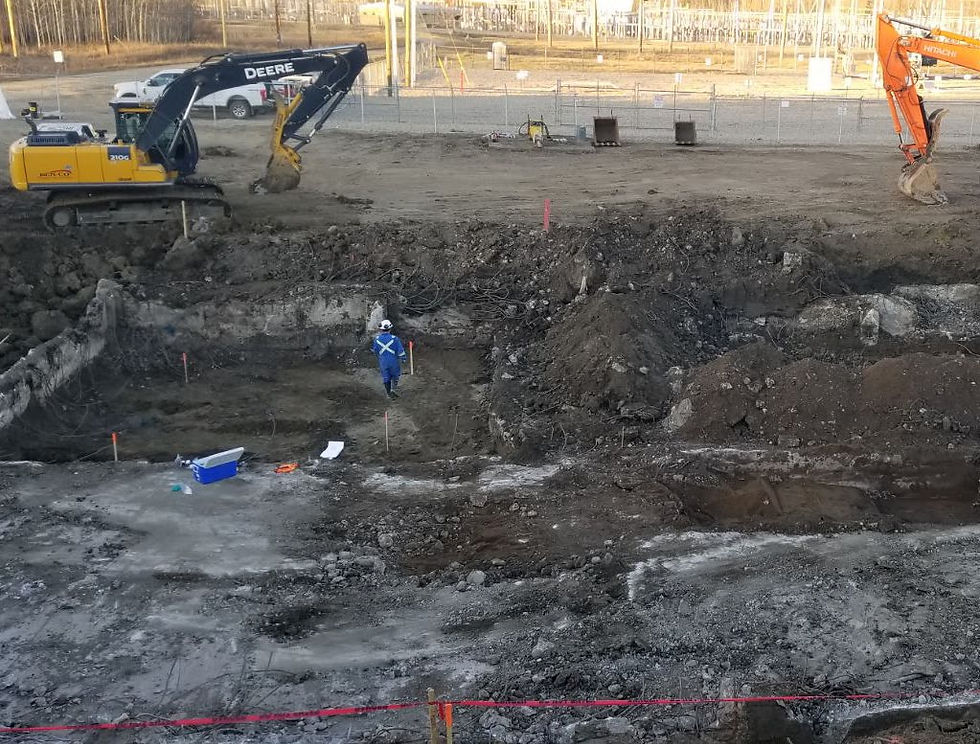
Resolve Earthworks & Environmental Ltd. was awarded the contract to remediate and reclaim a former power generating station. The worksite was in a remote area and was limited for space. The excavation posed a unique challenge in that it was known to contain concrete mixed with impacted soils, however the amount and condition of the concrete and rebar was unknown.
Resolve was awarded the project based on its price, project understanding and proposed work plan, as well as its safety record and proven capabilities on similar projects.
The project scope included the following:
Coordination with environmental consultant to develop the most cost-effective work plan to complete the remedial activities.
Daylight pipeline and communications lines in area of excavation.
Complete topographical survey of site.
Construct bermed, lined cell for stockpiling impacted soils.
During the excavation it was discovered that when the site building was previously demolished, large quantities of debris and metal were also buried with the concrete and impacted soils.
Resolve sorted and processed these waste streams and negotiated special disposal rates to reduce landfill costs.
Since the concrete was mixed with impacted soils, it was deemed contaminated and required disposal. However local landfills would not accept large pieces of concrete or rebar with the impacted soils.
Resolve proposed a plan to mobilize a concrete crusher and process concrete into smaller dimensions while removing rebar from the waste. This methodology allowed for local landfill approval, decreasing costs associated with trucking and disposal at alternate landfills.
Separate inert debris and metal from soils. Metal was shipped offsite and recycled as scrap while inert debris (~2,000 tonnes) was shipped to landfill.
Break concrete and remove select former building foundations to facilitate removal of underlying impacted soils.
Excavate, stockpile, transport, and dispose ~2,000 tonnes of impacted soils to a Class II landfill.
Import and stockpile clean fill. Place and compact clean fill in select areas of the excavation. Due to winter conditions the backfilling was put on hold until the following spring.
Resolve Earthworks & Environmental Ltd. was awarded the contract to remediate and reclaim a former power generating station. The worksite was in a remote area and was limited for space. The excavation posed a unique challenge in that it was known to contain concrete mixed with impacted soils, however the amount and condition of the concrete and rebar was unknown.
Resolve was awarded the project based on its price, project understanding and proposed work plan, as well as its safety record and proven capabilities on similar projects.
The project scope included the following:
Coordination with environmental consultant to develop the most cost-effective work plan to complete the remedial activities.
Daylight pipeline and communications lines in area of excavation.
Complete topographical survey of site.
Construct bermed, lined cell for stockpiling impacted soils.
During the excavation it was discovered that when the site building was previously demolished, large quantities of debris and metal were also buried with the concrete and impacted soils.
Resolve sorted and processed these waste streams and negotiated special disposal rates to reduce landfill costs.
Since the concrete was mixed with impacted soils, it was deemed contaminated and required disposal. However local landfills would not accept large pieces of concrete or rebar with the impacted soils.
Resolve proposed a plan to mobilize a concrete crusher and process concrete into smaller dimensions while removing rebar from the waste. This methodology allowed for local landfill approval, decreasing costs associated with trucking and disposal at alternate landfills.
Separate inert debris and metal from soils. Metal was shipped offsite and recycled as scrap while inert debris (~2,000 tonnes) was shipped to landfill.
Break concrete and remove select former building foundations to facilitate removal of underlying impacted soils.
Excavate, stockpile, transport, and dispose ~2,000 tonnes of impacted soils to a Class II landfill.
Import and stockpile clean fill. Place and compact clean fill in select areas of the excavation. Due to winter conditions the backfilling was put on hold until the following spring.